IB Curriculum


IB

The International Baccalaureate (IB) Diploma Program is a demanding two-year pre-university course of study designed for highly motivated secondary school students. The IB Diploma Programme is designed as an academically challenging and balanced programme of education with externally set, standardized final examinations supplied and assessed by the International Baccalaureate Organization (IBO). The program provides an internationally accepted qualification for entry into higher education and is recognised by many universities worldwide.


The International Baccalaureate program is developed independently of government and national systems, and incorporates quality practice from research and the global community of schools. The program:

  • encourages students of all ages to think critically and challenge assumptions;
  • encourages students of all ages to consider both local and global contexts; and 
  • develops multilingual students.

Students in the IB Diploma Program complete rigorous academic courses that, in many cases, go well beyond the regular secondary school curriculum. Additionally, students are expected to engage in extracurricular activities and to be active members of their local and greater communities. 

IB Diploma Course Offerings

In the International Baccalaureate Diploma Program, students study 3 subjects at the Higher Level (HL) and 3 subjects at the Standard Level (SL). Students are expected to take one course from each of the 6 subject groups: 

  • Group 1 - Studies in language and literature
  • Group 2 - Language acquisition* (there are no language exemptions)
  • Group 3 - Individuals and societies
  • Group 4 - Sciences
  • Group 5 - Mathematics
  • Group 6 - The Arts (Students may take an additional Group 2, 3 or 4 course, instead of a course in the arts.)

The Sir Wilfrid Laurier CI IB Diploma Programme consists of the following:

Sir Wilfrid Laurier CI

(Grade 9 entry)

French (Group 2)

Psychology (Group 3)

Chemistry (Group 4)

Physics (Group 4)

Mathematics A&A (Group 5)

English (Group 1)

Economics (Group 3)

Psychology (Group 3)

Biology (Group 4)

Chemistry (Group 4)


The Diploma Programme also includes Core Elements: 

  • Creativity, Activity and Service (CAS); extra-curricular learning and reflection in and around the school community; 
  • Extended Essay - a 4000 word independent post-secondary style research paper and; 
  • Theory of Knowledge course- an experiential course that examines how we know what we know.

Grade 9 & 10 - IB Diploma Preparation Programme (IB DPP)

To prepare students for the rigours of the IB Programme, students take their compulsory courses in Grades 9 and 10 with other IB DPP students as a cohort. The IB DPP Grades 9 and 10 follow the same semester schedule as all Grade 9 and 10 classes. To accommodate the additional material in the IB curriculum, Grade 9 and 10 IB DPP courses move through the Ontario Curriculum at an accelerated pace and incorporate extra units and activities specific to IB: for example, adding units to the Grade 9 and 10 courses, completing Grade 11 Ontario courses in the Grade 10 year, etc.
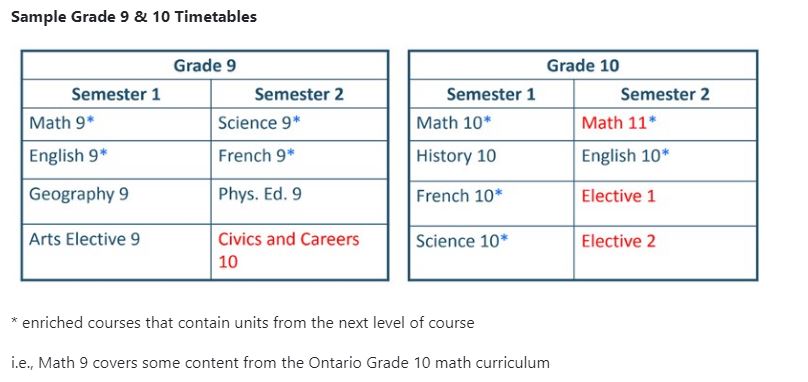
Sample TTs

Standardized Final Examinations and Accommodations:

All TDSB courses will ensure students requiring accommodations as outlined in Individual Education Plans (IEPs) are provided. Within the IB programme, evaluations are set and regulated by the International Baccalaureate Organization (IBO). During such evaluations, IEP accommodations may or may not be permitted by the IBO. 

While requests can be made to the IBO by the school, ultimately, the IBO determines the accommodations allowed for evaluation purposes. The IBO will look at the IEP, Psychoeducational Assessment and/or medical documentation and will determine which accommodations may be permitted. 

This may include 25% additional time, private space, computer options, etc.